In the modern digital world, you often come across strange strings of letters and numbers. Some look like passwords, others feel like tracking codes, and a few seem completely random. One such example is aazulpm5pyuq. At first glance, it does not look like anything meaningful. However, these kinds of codes play an important role in today’s technology-driven systems.
This complete guide explains what aazulpm5pyuq could represent, where such codes usually come from, why they appear, and how you should handle them. Moreover, this article walks you through real-world use cases, security implications, and practical steps to deal with similar codes in your daily digital life.
Even if this exact string does not point to a known brand, product, or public figure, understanding the logic behind such identifiers will help you stay safer, smarter, and more confident online.
What Is aazulpm5pyuq?
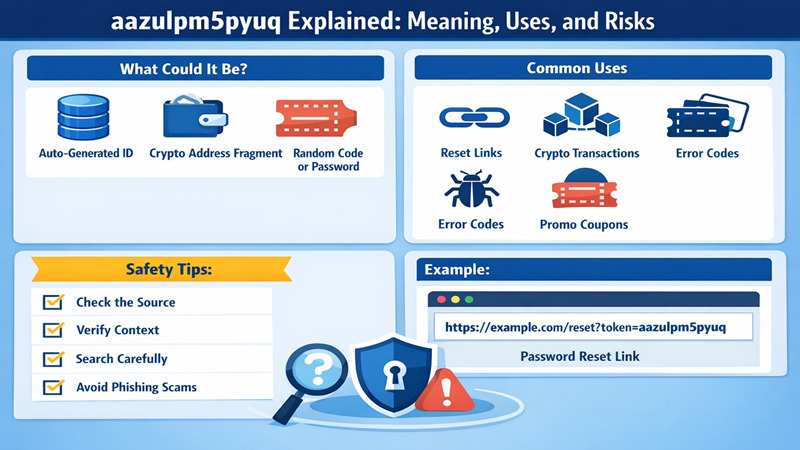
As of January 2026, aazulpm5pyuq does not match any known company name, product code, software error, or public database entry. Instead, it looks like a randomly generated alphanumeric string. In practice, such strings usually fall into one of the following categories:
-
An auto-generated ID used in databases or tracking systems
-
A fragment of a cryptocurrency wallet or transaction hash
-
A temporary token for login sessions or verification links
-
A one-time coupon code or access key
-
A randomly created password or API key
-
A typing mistake or a copy-paste error
Therefore, the value of this code does not come from its letters themselves. Instead, it comes from the context in which someone uses it.
Why Do Systems Generate Codes Like This?
Modern digital systems rely on unique identifiers. They use them to avoid confusion, prevent duplication, and secure data. Because millions or even billions of records exist, systems cannot rely on simple names like “User1” or “Order123.” Instead, they generate complex strings.
Here are the main reasons why:
1. Uniqueness
First of all, systems need unique values. A random-looking string almost guarantees that no two records will accidentally share the same ID.
2. Security
Secondly, unpredictable strings make it harder for attackers to guess valid IDs, tokens, or links. This practice protects accounts, sessions, and private data.
3. Scalability
Moreover, large platforms like Google, Facebook, or Amazon manage billions of entries. They need automated ways to create identifiers without human involvement.
4. Automation
Finally, computers generate and read such strings much faster than meaningful names. That speed improves performance and reliability.
Common Places Where You Might See Similar Codes
You may not notice it, but you already interact with such codes every day. Let’s explore the most common places where strings like this appear.
1. Website URLs
Many websites include random IDs in their URLs. For example:
-
A password reset link
-
A private file-sharing link
-
A session or authentication token
These links often contain strings that look meaningless, but they uniquely identify your request.
2. Database Records
Every modern application stores data in databases. Each record usually has a unique ID, which often looks like a random string.
3. Crypto Transactions
Blockchain systems use long alphanumeric hashes to represent wallet addresses and transactions. Sometimes, you only see a part of that long string.
4. Software Error Logs
Developers use unique codes to track errors and issues. If something breaks, the system logs a strange-looking identifier so engineers can find the exact problem later.
5. Coupon and Promo Codes
E-commerce platforms generate random codes to prevent people from guessing valid discounts.
Could aazulpm5pyuq Be a Security Risk?
On its own, a string like this does nothing. However, the context can make it important or dangerous.
Here are some situations where you should be careful:
-
If someone sends you a strange link containing such a code
-
If you find it in an email asking you to log in or verify something
-
If it appears in a message claiming you won a prize or need to fix an issue
In these cases, the code might be part of a phishing attempt or scam.
How to Evaluate an Unknown Code Safely
When you see a string like this, follow these steps.
Step 1: Check the Source
Ask yourself: Where did this come from?
-
Your own website or system?
-
An email from a company you trust?
-
A random message from a stranger?
The source tells you more than the code itself.
Step 2: Look at the Context
Next, see how it appears.
-
Is it part of a URL?
-
Is it inside a file name?
-
Is it mentioned in an error message?
Context gives meaning to the string.
Step 3: Do Not Enter It Randomly
Never paste unknown codes into websites, login pages, or software unless you fully trust the source.
Step 4: Search Carefully
You can search the code on Google. However, do not click on suspicious results. Sometimes, scammers create pages just for that purpose.
Step 5: Ask the Platform or Developer
If the code appears in your own system or website, check your logs, settings, or documentation. You will often find where it came from.
Real-World Examples of Similar Codes
To better understand how such strings work, let’s look at a few practical examples.
Example 1: Password Reset Token
When you click “Forgot Password,” the website sends you a link like:
That long string acts as a temporary key. It proves that you requested the reset.
Example 2: Order Tracking ID
E-commerce platforms often assign random-looking order IDs to prevent others from guessing how many orders exist.
Example 3: API Keys
Developers use API keys that look like long random strings. These keys control access to services and data.
Why Random Codes Matter for SEO and Websites
Since you run many websites and blogs, this part matters to you.
1. URL Structure
Search engines prefer clean and readable URLs. While random IDs work technically, they do not help users or SEO.
Better:
Worse:
2. Indexing and Crawling
If your site generates infinite random URLs, Google may waste crawl budget on useless pages.
3. User Trust
Visitors trust readable URLs more than strange-looking ones. Clean structure improves credibility.
Could It Be a Typo?
Sometimes, the simplest answer works best. A user might accidentally type or paste a random sequence. In that case, the string has no meaning at all.
Therefore, always consider human error before assuming technical complexity.
How Developers Generate Such Codes
Developers usually use:
-
Random number generators
-
Hash functions (like SHA-256, MD5, etc.)
-
UUID systems (Universally Unique Identifiers)
For example, a UUID looks like this:
Even though it looks messy, it follows a strict structure.
Best Practices If You Manage Websites
Since you own many SEO-driven sites, follow these tips:
-
Use readable URLs for public pages
-
Keep random IDs only for internal use
-
Protect tokens and keys from public exposure
-
Expire temporary codes automatically
-
Log and monitor how your system generates identifiers
Frequently Asked Questions
Is aazulpm5pyuq a virus?
No. A simple string of characters cannot be a virus. However, a link or file using such a string could be dangerous.
Can I decode it?
Without context, you cannot decode it. It does not follow any known public format.
Should I delete it?
If it appears in your own system logs or database, first find out why it exists. Do not delete blindly.
The Psychology of “Mysterious Codes”
Humans naturally look for patterns and meaning. When we see something like this, we assume it must hide a secret. In reality, most of these strings exist only to:
-
Identify something
-
Secure something
-
Track something
They do not carry human-readable meaning.
How This Knowledge Helps You
By understanding how these codes work:
-
You avoid scams and phishing traps
-
You design better, cleaner websites
-
You improve security awareness
-
You make smarter technical decisions
Final Thoughts
Even though aazulpm5pyuq does not match any known public identifier, it represents a very common concept in modern technology: random unique strings used for identification, tracking, and security. The string itself means nothing without context. However, the system using it gives it purpose.
The next time you see a similar code, do not panic. Instead, analyze the source, check the context, and decide your next step logically.
For more info visit lesbify