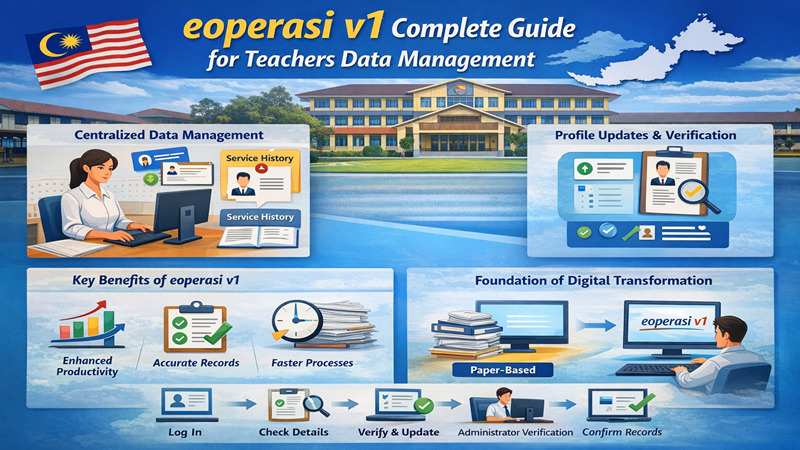
In the modern education system, digital record-keeping plays a critical role in managing teachers’ careers, school staffing, and administrative decisions. In Malaysia, the Ministry of Education (KPM) introduced several digital platforms to replace manual paperwork and fragmented databases. One of the most important early systems in this transformation is eoperasi v1.
Although newer versions now exist, this system still holds historical importance and continues to serve as a reference point for many records and processes. Understanding how it works, why it was created, and how it supports teachers and administrators helps you better understand the entire digital education ecosystem.
In this complete guide, you will learn what eoperasi v1 is, how it works, what its main features are, how teachers and administrators use it, what benefits it offers, and why accurate data management matters so much in the education sector.
What is eoperasi v1?
eoperasi v1 is an early official online management system introduced by the Ministry of Education Malaysia (KPM) to manage teachers’ and school staff service data in a centralized digital environment.
Before this system, most schools relied on:
-
Paper files
-
Manual forms
-
Local spreadsheets
-
Repeated data entry in different offices
This approach caused delays, errors, and data inconsistencies. To solve these problems, KPM introduced a centralized platform where teachers’ records could be stored, updated, and verified digitally.
The system focuses on:
-
Personal information of teachers
-
Academic qualifications
-
Teaching subjects
-
Service history
-
School placement records
-
Career-related administrative data
Because of this, it became a foundation for later systems and upgrades.
Why the Ministry Introduced This System
The main goal was simple: create one reliable and centralized database for teachers and school staff.
Before digitalization, the education system faced many problems:
-
Files went missing
-
Records became outdated
-
Transfers took too long
-
Promotions faced unnecessary delays
-
The data between departments did not match
By introducing a digital system, the Ministry aimed to:
-
Reduce paperwork
-
Improve data accuracy
-
Speed up administrative processes
-
Increase transparency
-
Support better planning and decision-making
As a result, schools and education offices could finally rely on a single source of verified information.
Core Purpose of the System for Teachers
Many teachers ask, “Why does this system matter to my career?” The answer is very practical.
The system exists to:
-
Store your official service record
-
Keep your qualifications and teaching subjects updated
-
Track your posting and placement history
-
Support transfer, promotion, and administrative decisions
-
Provide verified data to the Ministry
Because important decisions depend on this data, accuracy is essential.
Main Features of the Platform
Even as an earlier version, the system introduced several important digital features that changed how school administration worked.
1. Centralized Data Management
Teachers and administrators could store and manage:
-
Personal details
-
Academic certificates
-
Teaching subjects
-
Service duration
-
School posting history
Instead of maintaining separate files in different offices, everything lived in one centralized database.
2. Profile Updating and Verification
Teachers could submit updates, and administrators could verify them. This workflow helped reduce:
-
Duplicate records
-
Incorrect information
-
Missing data
3. Administrative Reporting
School leaders and district offices could generate reports for:
-
Staffing needs
-
Subject distribution
-
Experience levels
-
Transfer planning
This feature supported better long-term planning.
4. Foundation for System Integration
Although integration was limited in the early stage, this system laid the groundwork for later connections with platforms like HRMIS, SPS, and ePangkat.
How Teachers Used the System
From a teacher’s point of view, the system served as a digital career record.
Teachers typically used it to:
-
Check their personal and service details
-
Ensure qualifications were recorded correctly
-
Verify teaching subjects and postings
-
Report changes to administrators
-
Confirm that the records matched the official documents
Although the interface was simpler than modern platforms, it still represented a huge improvement over paper-based systems.
How Administrators Used the System
For administrators, the system became a central control panel for staff data.
They used it to:
-
Verify teachers’ submitted information
-
Update records based on official documents
-
Prepare staffing reports
-
Support transfer and placement decisions
-
Maintain accurate school databases
Instead of searching through cabinets of files, they could access everything digitally.
Benefits of Using the System
Even as a first-generation platform, it delivered strong benefits.
1. Better Productivity
By reducing paperwork and manual copying, schools saved a lot of time. Administrators could process updates faster, and teachers did not need to submit the same documents repeatedly.
As a result, everyone could focus more on teaching and learning instead of administration.
2. Improved Data Accuracy
Because data lived in one place and followed a verification process, the system reduced:
-
Typing errors
-
Conflicting records
-
Outdated information
Accurate data leads to fairer and faster decisions.
3. Faster Administrative Processes
Transfers, postings, and service confirmations moved more quickly because officers could access records instantly instead of requesting files from multiple offices.
4. Stronger Transparency
Teachers could see what the system recorded about them. This visibility helped build trust and reduced misunderstandings.
Why Accurate Data Matters So Much
Some people think profile updates are not important. In reality, incorrect data can cause serious problems, such as:
-
Delayed promotions
-
Problems in transfer eligibility
-
Errors in service recognition
-
Administrative disputes
Therefore, teachers should always:
-
Check their records regularly
-
Report mistakes immediately
-
Keep copies of official documents
-
Ensure updates are verified
Your digital record represents your professional history.
Common Mistakes Teachers Made
To use the system effectively, teachers had to avoid these mistakes:
-
Ignoring profile checks for years
-
Assuming administrators would fix everything automatically
-
Submitting incomplete information
-
Not following up on verification status
Even in a digital system, user responsibility still matters.
Security and Data Protection
Because the system stored sensitive personal and career data, security was always important.
The platform used:
-
User authentication
-
Access control levels
-
Administrator permissions
Teachers also had a responsibility to:
-
Keep their login details private
-
Avoid using shared computers without logging out
-
Report suspicious activity
Role in Malaysia’s Digital Education Transformation
This system was not just a database. It was one of the first major steps toward full digital transformation in education administration.
Later systems built on its foundation by adding:
-
Better interfaces
-
Deeper integration
-
More automation
-
Faster workflows
Without this early platform, later improvements would not have been possible.
How It Connects to Newer Systems
Over time, KPM introduced newer platforms and modules. These newer systems:
-
Expanded features
-
Improved user experience
-
Integrated more services
-
Reduced manual steps even further
However, historical data and structural ideas came from this early platform.
A Simple Step-by-Step Usage Routine (Then and Now)
A good practice that started with early systems and still applies today is:
-
Log in to the system
-
Review your profile data
-
Check qualifications and service records
-
Report or request corrections if needed
-
Wait for administrator verification
-
Recheck after approval
This habit protects your career records.
A Short Note on Digital Careers and Data
Around the world, digital systems now shape careers. You may have heard about the viral $900,000 AI job that showed how valuable digital skills and systems have become.
In education, the situation is different, but the principle is the same:
Your data and how it is managed can directly affect your professional future.
That is why platforms like this matter.
Limitations of the Early System
As a first-generation platform, it had some limitations:
-
Simpler interface
-
Slower performance compared to modern systems
-
Limited integration with other platforms
-
More manual steps for administrators
However, at the time, it still represented a massive improvement over paper-based processes.
Why the System Still Matters Today
Even if newer versions now exist, this platform still matters because:
-
It holds historical records
-
It shaped current workflows
-
It introduced digital culture in school administration
-
It proved that centralized data management works
Understanding it helps you understand how the entire system evolved.
The Future of Education Data Management
As technology continues to improve, education management systems will:
-
Become more automated
-
Use better analytics
-
Offer faster and more transparent services
-
Reduce human error even further
However, the basic idea will remain the same: accurate, centralized, and verified data.
Final Thoughts
eoperasi v1 played a crucial role in modernizing how the Ministry of Education Malaysia manages teachers’ data. It replaced slow, error-prone paper systems with a centralized digital approach that improved productivity, accuracy, and transparency.
For teachers, it became a digital record of their professional journey. For administrators, it became a powerful management and planning tool. And for the education system as a whole, it marked the beginning of a new, more efficient era.
For more info visit Lesbify